

INFORMATION FOR VISITORS
The Museum is open daily, except Monday (and the last day of each month), from 10:00 to 18:00. Ticket sales end 30 minutes before closing time.
Admission
Adults: 500 tenge
Schoolchildren and students of art institutions: 200 tenge
Pensioners and students: 300 tenge
WWII veterans, labour veterans, disabled persons, children under the age of 7 and museum employees: free
For information, please call: +7 (727) 394 57 15
Аccording to the Ministry of Culture and Sports’ instruction, every third Sunday of the month admission to our Museum will be free. Free admission will be also for the school students during all school breaks.
Address:
A.Kasteyev State Museum of Arts of the Republic of Kazakhstan (opposite the National Bank)
22/1 Koktem-3 microdistrict,
Almaty, Republic of Kazakhstan
Contact form
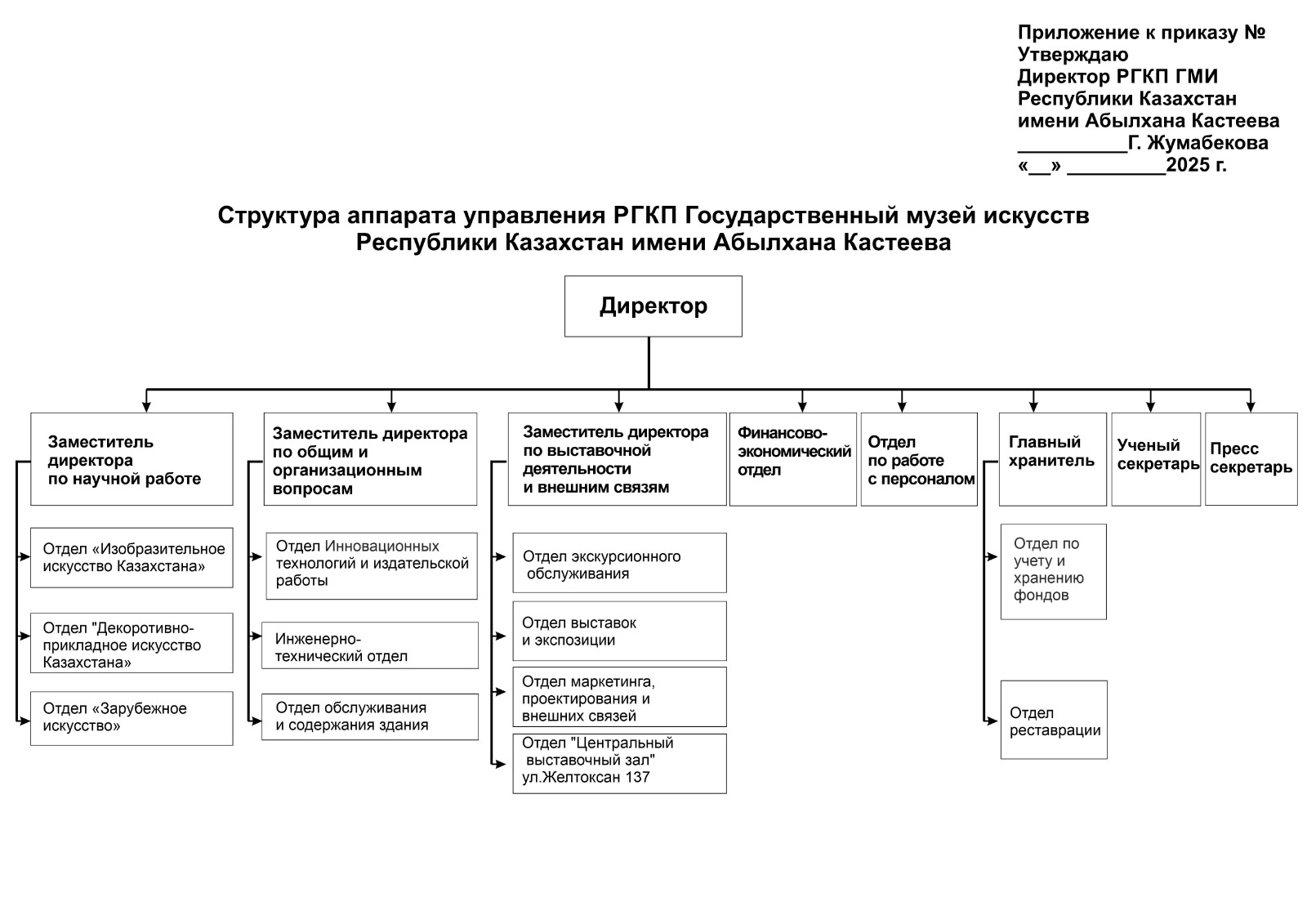
Museum structure
Director (reception) tel. +7 (727) 394 5519
Deputy for general questions tel. +7 (727) 394 5709
Deputy on science tel. +7 (727) 394 5702
Deputy for exhibitions tel. +7 (727) 394 5726
Press Secretary tel. +7 (727) 394 5718
Tel. +7 (727) 394 5719
Tel. +7 (727) 394 5525
The house of the famous artist Abylkhan Kasteev was handed over to the state by his family in March 2004 for the opening of the artist's museum there. This year was considered the year of A. Kasteev and the celebrations in honor of the 100th anniversary of the artist were held under the auspices of UNESCO. The House-Museum of the Artist at the State Museum of Arts named after A. Kasteev with the placement in it of the Center for the Study of A. Kasteev's Heritage was opened on February 17, 2014
The building is a one-story house of the mid-twentieth century, now a monument of history and culture, built by the order of the Chairman of the Council of Ministers of the Kazakh SSR D.A. Kunaev in 1955 (this position was held by D.A. Kunaev from 1955 to 1960), specially for the large family of A. Kasteev. In 1958, the artist and his family moved to this house, however, in 1966 it was completely demolished and another was built in its place. a workshop was attached to the house, where the artist created various works of art. The construction of the house was carried out according to the project of the chief architect of Almaty, Orazymbetov N. The house is located in the eastern part of Almaty, behind the Malaya Almatinka river on Bekhozhin street (formerly Gorodskaya street). The house has been preserved in its original form: living room, 3 bedrooms, workshop, kitchen, bathroom, veranda; there is a garden attached to the house.The total area of the museum is 0.7 hectares, the total area of the house is 142.5 m2 , of which exposition and exhibition-100m 2 , service-40m 2 .
A. Kasteev lived and worked in the house since 1958. until the end of his life - November 2, 1973. In the workshop, the artist created such canvases as "Sarbazy Amangeldy", "Turksib", "Kapchagai hydroelectric power station", "Kenen Azerbaev", numerous watercolor works. Painters, actors, writers, poets, musicians, teachers, students, journalists, fellow countrymen and numerous relatives gathered in the house. It talked about art, about pressing problems, their solutions and much more. This house was visited by the brightest representatives of the Kazakh intelligentsia: the famous composer Nurgisa Tlendiev, the dancer Shara Zhienkulova, the artist from Uzbekistan Oral Tansykbaev, the artist from Kyrgyzstan Gappar Aitiev, the cameraman and film director - Iskandir Tynyshpaev (son of the Kazakh public figure, a member of the "Alashidjana" Mukhampaev).The famous Kastey tea drinking at the samovar in the gazebo was not just a rest, here they talked about art, discussed, discussed the latest cultural achievements, dreamed about the future of the country. This house received various foreign delegations: an American delegation headed by Rockwell Kent, a delegation of artists from Armenia, Mongolia, and Hungary. Artists of the older generation were regulars at these creative tea parties: Khakimzhan Nauryzbaev, Moldakhmet Kenbaev, Uke Azhiev, Sakhi Romanov, Aubakir Ismailov, Zhanatay Shardenov and many others.Artists of the older generation were regulars at these creative tea parties: Khakimzhan Nauryzbaev, Moldakhmet Kenbaev, Uke Azhiev, Sakhi Romanov, Aubakir Ismailov, Zhanatay Shardenov and many others.Artists of the older generation were regulars at these creative tea parties: Khakimzhan Nauryzbaev, Moldakhmet Kenbaev, Uke Azhiev, Sakhi Romanov, Aubakir Ismailov, Zhanatay Shardenov and many others.
The exposition of the House-Museum presents things and objects of A. Kasteev and his family members. Each exhibit is an object of the creative process or household use: furniture, easel, household items, sketchbooks, boxes, hand-made graphics made by A. Kasteev, convenient for storage and transportation, photographic materials, archival documents.
The A. Kasteev Heritage Research Center is engaged in the collection and study of the artistic heritage of Abylkhan Kasteev, educational and educational activities. The House-Museum of A. Kasteev hosts various thematic events dedicated to the life and work of the artist. In addition to the permanent exposition, exhibitions of children's and youth's artistic creativity are exhibited, excursions are held, creative meetings with artists and other creative intelligentsia,
Opening hours:
Tuesday 10:00 - 17:00
Wednesday 10:00 - 17:00
Thursday 10:00 - 16:00
Inquiries by phone - 241-32-09
House-Museum of A. Kasteev is located at the address: Almaty, Bekhozhin street, house number 6-A
Art laboratory invites everyone
The most daring experiments in the field of art. Let yourself plunge into the world of creativity and creative ideas together with the ART LABORATORY of the Kasteev Museum.
The schedule and cost of classes can be specified by phone: +7 (727) 394 5715
The "Foreign Art" department unites several sections: "Russian art of the 17th - early 20th centuries." ", as well as works of the near and far abroad. The tasks of the department are to study, systematize, and promote foreign art.
The collection of the department is distinguished by a high artistic level, historical sequence, a variety of national schools, a wide range of styles and trends.
The employees of the department carry out research work: compiling catalogs of the collection, attribution of works, participation in scientific-practical and theoretical conferences, publications in collections of scientific papers, participation in presentations at conferences of various levels.
An important part of the department's activities is exhibition work: drawing up thematic and exposition plans for permanent and temporary exhibitions, preparing advertising materials for the department's exhibitions. Contacts with visitors are very important - these are excursions and lectures. The scientific staff of the center give lectures on world art and conduct excursions to all the halls of the museum.
The department actively cooperates with various foreign museums and public organizations - Pushkin Museum im. A.S. Pushkin, the St. Petersburg State Museum-Institute of the Roerich Family, the State Russian Museum, the State Memorial Historical, Art and Natural Museum-Reserve of V.D. Polenov (Russia), the Cultural Inventory Foundation (Holland), the Consulate General of China and the Cultural Center of Japan in Almaty, the Museum of Ceramics and Porcelain (Jingdezhen, China), etc.
The employees of the department are graduates of art and culture universities, whose professional efforts, experience and skills are aimed at fulfilling the main task of the museum - popularizing all types of museum activities, its collection, all world art by providing excursion and lecture services. Employees of the department develop and apply in practice various forms of cultural and educational activities, organize practical classes in the field of fine and decorative arts, maintain contact with higher educational institutions, with schools.
One of the main tasks of the department is to popularize all types of the museum's activities, its collection, and all world art.
The main activities of the center:
- Cultural and educational work (organization of lectures and excursions, development and implementation of educational programs, etc. various forms of work);
- Information and educational and exhibition work (communication with educational institutions of all levels, art universities, funds and other organizations of the city, distribution of invitation cards);
- Scientific and methodological work (preparation of new topics for excursions, development of new topics of lectures, participation in seminars and conferences, preparation of reports for them).
Tel. +7 (727) 394 5715
The main goals and objectives of the department are:
- scientific exposition work;
- development of thematic and exposition plans for the permanent exhibition
- (jointly with research centers) and temporary exhibitions;
- preparation and coordination of annual exhibition plans;
- organization of work on holding temporary exhibitions and permanent expositions;
- provision of storage of exhibits in the halls and galleries of the museum;
- work with museum caretakers;
- writing festive slogans, newspapers, announcements, booth decoration;
EMPLOYEES
The exposition forms the basis of museum communication, which is carried out through, first of all, the visual perception by visitors of the exposition material placed in a certain space.
The GMI exposition occupies two floors of the building in 11 halls and 10 galleries. Most of them are occupied by a permanent exhibition, which presents a rich and varied collection, which gives a vivid idea of the artistic culture of Kazakhstan, Soviet art, countries of Western Europe and the foreign East, acquaints with the work of masters of past eras and the present.
The creation of a museum exposition is a complex research, creative and production-technical process that requires joint efforts of scientists, artists, designers, engineers. The creation of a musical exposition begins with a preliminary systematic development of the scientific content of the exposition, its architectural and artistic solutions and technical equipment. Therefore, the components of the design of the exposition are: scientific design, during which the main ideas of the exposition and its specific content are developed, artistic design designed to provide a figurative, plastic embodiment of the theme, technical and working design, which fixes the place of each exhibit, text and technical means.The Center for Exhibitions and Exhibitions, together with scientific departments, carries out a large scientific work to create permanent exhibitions from the museum's funds.

The Center for Exhibitions and Expositions, together with other research centers, participates in the development of a scientific concept (objects in the museum exposition represent a scientifically organized set, since their selection and placement are based on a scientific concept developed by the museum team). The scientific concept should reveal the concept of the exposition, give a general idea of the future exposition. It defines the goals and objectives of the exposition, its main problems and thematic structure, gives a characteristic of the exposition materials and suggests methods of their presentation. In the scientific concept, with the participation of the artist, the work on the compilation of the theme is determined - the exposition plans. As a rule, the TEP includes: the names of sections, topics, thematic complexes, leading texts and annotations,lists of exhibits indicating the main attributive data, etc. A label is attached to the thematic - exposition plan (an indispensable element of any exposition is a label - this is a text containing the name of an object, its attributive data).
The center works not only on a permanent exhibition, but also creates temporary exhibitions - exhibitions, stationary or traveling. The exhibitions often show items from other museums or private collections, personal author's exhibitions, thematic exhibitions, exhibitions from fund depositories, reporting exhibitions are held.
actively cooperates with the British Council, the Goethe Institute, practically with all embassies and consulates. Therefore, we have the opportunity to annually present to visitors interesting exhibitions held in conjunction with the above organizations.
